
How to Compare Two Franchise Opportunities in Canada
How to Compare Two Franchise Opportunities in Canada - A Simple Scorecard
.
Choosing between two franchise opportunities can be surprisingly difficult. On the surface, many franchises appear similar. Both may offer recognizable brands, structured systems, and support for new owners.
However, once you look more closely, meaningful differences often emerge. The level of training, the strength of the brand, financial requirements, territory protections, and long-term obligations can vary significantly.
For anyone considering buying a franchise in Canada, comparing opportunities systematically is essential. Rather than relying on instinct or marketing materials, a structured scorecard can help you evaluate options objectively.
This guide explains how to compare two franchise opportunities using a practical framework. The goal is not to “rank” brands in a vacuum, but to help you determine which opportunity may be the better fit for your goals, resources, and risk tolerance.
If you are just beginning your research, you may also want to review our guide on buying a franchise and what the early investigation process typically involves.
.
Why a Scorecard Helps Franchise Buyers
.
When exploring franchises, it is common to focus first on brand familiarity. A well-known concept may feel safer than a lesser-known one.
However, brand recognition is only one factor in a much larger decision.
A scorecard helps you compare opportunities across multiple dimensions, such as:
- Total investment required
- Ongoing fees and royalties
- Training and support
- Territory protections
- Franchise agreement terms
- Operational complexity
- Skill and lifestyle fit
- Market demand in your area
Many prospective franchisees begin their search by browsing franchise opportunities across different industries. From there, the challenge becomes narrowing the field to one option that aligns with both financial and lifestyle goals.
A structured comparison prevents small but important differences from being overlooked.
.
.
The Franchise Comparison Scorecard
.
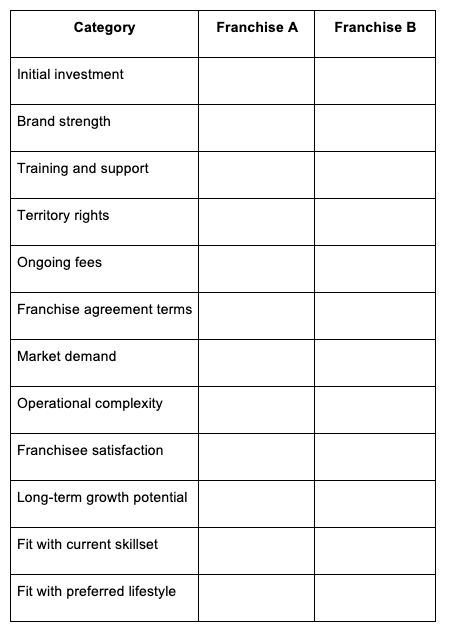
Below is a simple framework that can be used to compare two franchise opportunities. You can score each category from 1 to 5, where:
- 1 = weak or uncertain
- 3 = average
- 5 = strong or favourable
.
.
This type of scorecard allows you to compare opportunities across consistent criteria instead of relying on impressions alone.
.
1. Initial Investment Requirements
.
The total cost of opening a franchise can vary widely, even within the same industry.
Investment levels may include:
- Franchise fee
- Leasehold improvements
- Equipment
- Initial inventory
- Opening marketing
- Working capital
Some franchise systems require significant build-out costs, while others can operate with lower overhead.
Understanding the full investment picture is critical before comparing opportunities. A lower franchise fee does not necessarily mean a lower total investment.
When scoring this category, consider:
- Total capital required
- Personal investment needed
- Access to financing
- Estimated operating reserves
A franchise with slightly higher investment requirements may still be preferable if it offers stronger support or brand recognition.
.
2. Brand Strength and Market Recognition
.
Brand strength plays an important role in franchise success. Established brands often provide built-in customer awareness and marketing support.
However, not every strong franchise brand is widely known nationally. Some concepts succeed and thrive by dominating a regional market or serving a niche segment.
When comparing brands, consider:
- Years in operation
- Number of franchise locations
- Growth trajectory
- Consumer reputation
- Online reviews and customer sentiment
Brand recognition can influence early sales performance, but it should not be the only factor in your decision.
.
3. Training and Ongoing Support
.
One of the key advantages of franchising is access to structured training and operational guidance.
Training programs vary significantly between systems. Some provide comprehensive onboarding programs that include classroom training, on-site assistance, and operational manuals. Others may rely more heavily on remote learning or shorter training sessions. Effectiveness will depend on the depth of the information provided, the complexity of the business model and your learning style.
When comparing two opportunities, evaluate:
- Length of initial training
- Location of training programs
- Ongoing operational support
- Field support visits
- Access to marketing assistance
- Franchisee peer networks
Strong support systems make a significant difference, particularly for first-time business owners.
.
4. Territory Protection and Market Size
.
Many franchise systems offer exclusive or protected territories. These agreements prevent other franchisees from opening competing locations within a defined geographic area.
However, territory structures can vary.
Some systems provide clearly defined geographic boundaries, while others rely on population density or proximity guidelines.
When reviewing franchise disclosure materials, ask questions about:
- Territory size
- Population coverage
- Online sales policies
- Future expansion plans
Understanding these factors is important because your territory will affect long-term revenue potential.
.
5. Ongoing Fees and Royalty Structure
.
Most franchise systems require ongoing payments to the franchisor.
These may include:
- Royalty fees
- Advertising fund contributions
- Technology fees
- Renewal fees
Royalty structures are typically based on a percentage of revenue, although some systems charge flat monthly fees.
When comparing opportunities, look beyond the royalty percentage itself. Consider what those fees provide in return.
For example:
- National marketing campaigns
- Digital advertising support
- Brand management
- Operational tools
- Supplier networks
Our article on What Are You Really Paying For When You Buy a Franchise explains how these costs work within franchise systems.
A franchise with slightly higher fees may still provide stronger value if the support and brand recognition justify the cost.
.
6. Franchise Agreement Terms
.
The franchise agreement outlines the legal relationship between franchisor and franchisee.
These contracts typically cover:
- Term length
- Renewal conditions
- Territory rules
- Operational requirements
- Non-competition clauses
- Exit or resale rights
While most franchise agreements share similar structures, the details can vary widely.
For example, some agreements require major renovations before renewal. Others may include strict operational standards or technology requirements.
Understanding these details is essential before signing any franchise contract. Because franchise agreements are complex legal documents, BeTheBoss.ca strongly recommends consulting a specialized franchise lawyer during the review process. See our article Do I Need a Lawyer Before Signing a Franchise Agreement? to learn more about why this is important.
.
7. Market Demand and Industry Stability
.
Not all industries perform the same in every market. A franchise concept that performs well in one region may face different conditions elsewhere.
When comparing two opportunities, consider:
- Local competition
- Consumer demand
- Economic trends
- Demographics
- Population growth
For example, service-based franchises in home services, pet care, and senior care have experienced strong growth in many Canadian markets. If you are considering a more traditional franchise such as fast-food or retail, be sure that you have limited competition for your product, and that the format is in high demand in your area.
Evaluating local market demand can help ensure that your chosen franchise concept aligns with long-term consumer needs.
.
8. Operational Complexity
.
Some franchise systems require more day-to-day operational involvement than others.
Operational complexity may depend on factors such as:
- Staffing requirements
- Inventory management
- Equipment maintenance
- Extended operating hours
- Specialized training
For instance, food service franchises often involve more operational complexity than service-based models.
When scoring this category, consider how the operational requirements align with your experience and lifestyle goals.
.
9. Franchisee Satisfaction and System Culture
.
One of the most valuable sources of information during franchise research is existing franchisees, and in Canada you have the right to speak with them before finalizing your decision.
Current operators can provide insight into:
- Day-to-day challenges
- Franchisor communication
- Operational support
- Profitability expectations
- System culture
Most franchise disclosure documents include contact information for current and former franchisees.
Speaking directly with operators can reveal insights that may not appear in marketing materials. Here is a list of questions to get you started when you speak to an existing franchisee. 12 Questions to Ask Existing Franchisees as part of Due Diligence
.
10. Long-Term Growth Potential
.
Consider how each franchise system plans to grow.
Growth potential may include:
- Expansion into new markets
- Development of additional services
- Technology investments
- Marketing innovation
A franchise system that is actively evolving may provide stronger long-term opportunities for franchisees.
However, rapid expansion can also introduce operational challenges. It is important to evaluate whether the franchisor has the infrastructure to support continued growth and the speed of their growth plans while still properly supporting their franchisees.
Understanding the broader franchise system is an important part of evaluating a franchise opportunity and deciding whether it aligns with your long-term goals.
.
11. Fit with Current Skillset
.
Not every franchise requires direct industry experience, but many look for strengths like leadership, communication, sales ability, organization, and the willingness to follow a proven system. Being honest about what you do well (or not) helps you narrow your options and match your natural abilities.
The right fit can make day-to-day operations smoother, training easier, and long-term success more realistic. When your strengths align with the demands of the franchise, you are more likely to feel confident, stay motivated, and grow the business effectively.
- Identify your transferable skills
- Consider your comfort with brand systems and standards.
- Review your management and leadership style.
- Decide if you can handle the pace, structure, and demands of the brand.
- Determine if training can bridge experience gaps.
.
12. Fit with Preferred Lifestyle
.
Choosing a franchise that fits your preferred lifestyle is just as important as matching your skills or budget. A business may look appealing on paper, but if it doesn’t suit your schedule, energy, family priorities, or long-term goals, it can quickly become the wrong fit.
Lifestyle alignment matters because franchise ownership affects your daily routine, flexibility, stress level, and work-life balance. In fact, many people leave their current roles for this very reason. The better the fit, the more sustainable and rewarding the opportunity is likely to be.
- Consider your ideal schedule
- Think about family demands
- Review time commitment
- Assess stress tolerance
- Match long-term goals
.
Using the Scorecard to Make a Final Decision
.
After scoring each category, review the results carefully.
The highest total score does not automatically determine the best choice. Instead, the scorecard highlights where one opportunity may be stronger than another.
For example:
- One franchise may offer stronger brand recognition.
- Another may require lower investment and provide better territory protection.
The right decision ultimately depends on your priorities, financial capacity, and long-term goals.
Franchising can provide a structured pathway into business ownership, but every opportunity carries different advantages and risks. Taking the time to compare options methodically can help reduce uncertainty and support a more confident investment decision.
.
Final Thoughts
.
Comparing franchise opportunities requires more than reviewing marketing brochures or franchise discovery day presentations.
A structured evaluation process allows prospective franchisees to assess each opportunity objectively and understand the trade-offs involved.
By reviewing investment requirements, brand strength, support systems, territory rights, legal obligations, your abilities, lifestyle priorities and market demand, you can develop a clearer picture of which franchise opportunity aligns best with your goals.
If you are still exploring different options, you can browse a wide range of franchise opportunities in Canada to begin building your shortlist.
.